Within
Normal Limits
of
Reason

"Chance is the very guide of life"

"In practical medicine the facts are far too few for them to enter into the calculus of probabilities... in applied medicine we are always concerned with the individual" -- S. D. Poisson

November 21, 2005

NEJM - . . . And a Diagnostic Test Was Performed (Greenwald 2005)


A correspondence from Dr. Robert A. Greenwald, describing a recent case conference during which a patient with IPEX was diagnosed by a fellow in attendance using not her clinical acumen per se but Google.

Where does this lead us? Are we physicians no longer needed? ... Even worse, the Google diagnostician might be linked to an evidence-based medicine database, so a computer could e-mail the prescription to the e-druggist with no human involvement needed. The education of house staff is morphing into computer-search techniques. Surely this is a trend to watch.


Search Google Book Search (formerly Google Print) with "IPEX immunodeficiency"...

Do we even need medical libraries? From my laptop, I can access publication quality, full color, annotated dermatology pictures, and pathology slides (and the entire BluePrint review book series)! Indeed Google Book Search turned out quite useful the other day when we admitted a patient with a strange rash.


Technorati Tags:

November 20, 2005

Science 2.0 - Peer-reviewed publications


Robert Boynton gives us a cautionary tale of then-University of Chicago political science junior faculty Daniel Drezner. He was denied tenure because part of his academic output had been directed into the blogosphere.

The current antipathy toward blogging may have something to do with the fact that universities have no tools for judging blogs. And most people agree that blogs would need to be evaluated through some kind of peer-review mechanism if they are to be taken into account. "It is utterly absurd to propose giving someone credit for activity with no barriers to entry," [John Holbo, the Editor of The Valve] says.

So, how might a blog be peer-reviewed? The market provides a number of viable models. eBay, for one, has established an efficient rating system for buyers and sellers, based on the number and quality of transactions they execute. In a noncommercial medium, Slashdot uses a "Moderation and Meta Moderation System," in which moderators are awarded higher or lower "karma" according to how well they police the discussions on the site. (The "Meta Moderation System" judges the moderators' moderators.)


An even better model is Kuro5hin.org, which I think has successfully adapted the peer-review process to the Web. The manuscript submission process should sound familiar:
  1. The author contribue articles by formatting the manuscript (or "stories" in the world of Kuro5hin) with respect to a standard recommendation.

  2. The author submits the manuscript to the edit queue, along with plans for editing the manuscript

  3. A subset of Kuro5hin users are selected to be editors of this particular mansucript. They see a link to the manuscript in their Kuro5hin "moderation" pages. At this point, the text is not visible to the rest of the Kuro5hin community.

  4. Editorial commments are visible to the author, who can respond to the comments, make changes to the manuscript, and even rate the usefulness of each individual editorial comment

  5. Editors vote on acceptance of this manuscript

  6. Assume it is accepted, the manuscript becomes an article. Another subset of Kuro5hin users are select to vote on the placement of the article: on the Frontpage or in one of the Sections (e.g., Politics, Technology, Culture, etc).

  7. Now the entire Kuro5hin community can read the article and comment.

  8. Each reader can rate other readers' comments. The author can likewise respond to the questions and comments.


Possible improvements:

  • Allow editors to tack on metadata to the text. This seems a natural task for editors, who will be doing fact-checking as a part of the editing process.

  • Allow for multiple authors per manuscript for collaborative efforts.

  • Anonymous editorial process to encourage frank discussions.

  • Giving some structure to the comment system, making it easier to track questions that have been answered by the author and those that have not.

  • As noted by many, a credit system for rewarding editorial work and constructive comments.


John Holbo's post on this on The Valve.


Technorati Tags:

November 19, 2005

Science 2.0 - How To Guide to CiteULike


As the world flattens, people-to-people and machine-to-machine communication becomes standardized and efficient, how do we as scientists find new ways to plug into this new infrastructure and collaborate with each other in the 21st century?

An article at OpenWetWare talks about the emergence of Science 2.0. See the accompanying brainstorming Wiki for even more inspiring ideas.


Web1.0-->Web2.0
Britannica Online-->Wikipedia
...
Science 1.0-->2.0

Some drawbacks of the current situation
  • There is only one main level of information dissemination: peer-reviewed, highly polished summaries of work in journals.

  • ...
  • Current publishing approaches do not encourage open feedback and reviews of work.


Pubmed --> Faculty of 1000 --> Cite-U-Like


What is CiteULike? Like del.icio.us, CiteULike is a social bookmarking service. But it is specifically tailored to academic discussions. Mechanisms are in place to automatically create records of journal articles, tag them, and discuss them with other users of CiteULike. Connotea is a similar service hosted by the Nature Publishing Group. But the CiteULike website is more responsive, its user interface more intuitive, and its comment system more amenable to public discussions.

I have created groups in CiteULike where we could review and discuss recent articles in evidence-based medicine and randomized clinical trials methodology.

To get started:

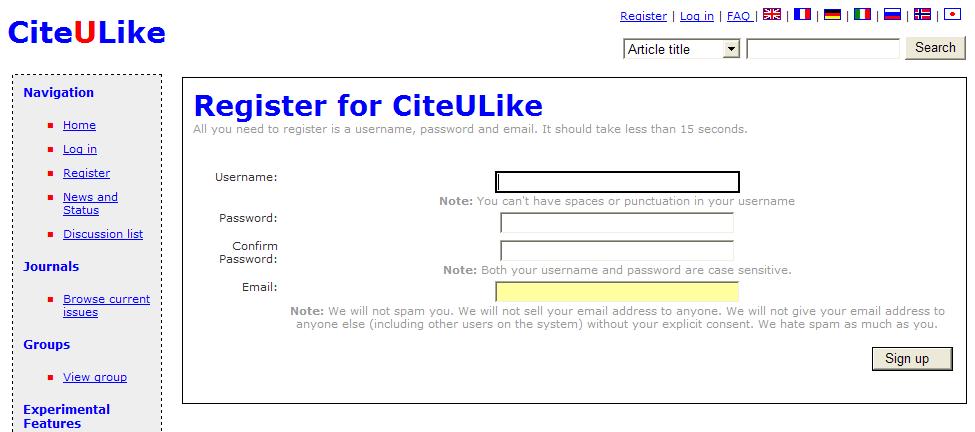
  1. Register at CiteULike


  2. Install the bookmarklet on this page appropriate for your machine. Make sure to bookmark it into a toolbar for easy 1-click access.


  3. Go to the PubMed page of the article you want to comment on, and click the bookmarklet button


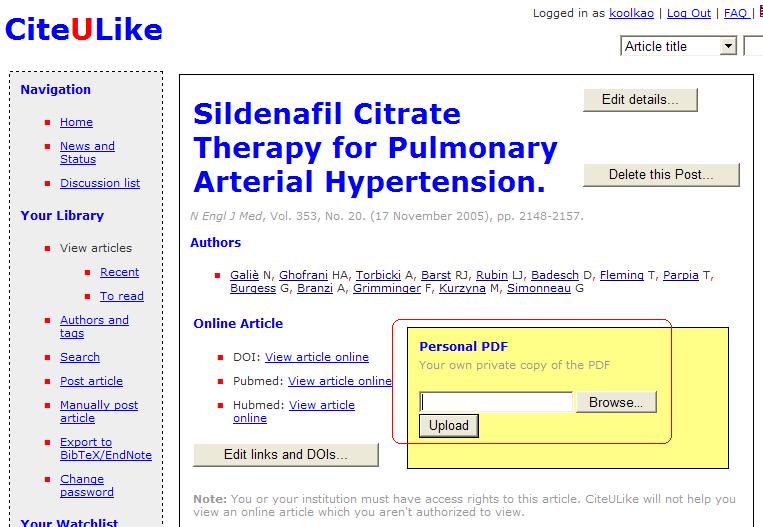
  4. Tag this post, leave public or private notes, and even upload your PDF file for later access.


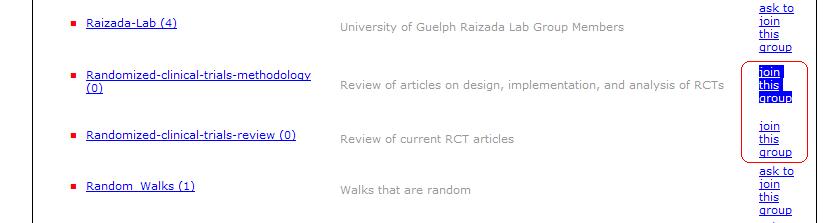
  5. Go to the CiteULike groups page to join discussion groups. If you'd like, join the groups Evidence-based-medicine, Randomized-clinical-trials-methodology, and/or Randomized-clinical-trials-review


Technorati Tags: